Clinical Case Scenario
A 29-year-old previously healthy primigravida undergoes an emergency caesarean section for placental abruption at 37 weeks of gestation. The procedure is complicated by massive postpartum hemorrhage (estimated blood loss 5.2 L), profound hemorrhagic shock, and disseminated intravascular coagulation. She receives massive transfusion (12 units packed red blood cells, fresh frozen plasma, platelets, and cryoprecipitate), vasopressor support, and correction of coagulopathy.
On admission:
- Hemoglobin: 5.5 g/dL
- Platelets: 52 × 10⁹/L
- INR: 2.8
- Fibrinogen: 85 mg/dL
- Lactate: 10.2 mmol/L
- Serum creatinine: 0.8 mg/dL
Over the next 72 hours:
- Hemodynamic status normalizes.
- Vasopressors are discontinued.
- Lactate- 1.3 mmol/L.
- Coagulation profile normalizes.
- Platelet count recovers to 105 × 10⁹/L.
Despite recovery from shock, she remains anuric (<20 mL/day), and serum creatinine increases to 7.4 mg/dL with hyperkalemia requiring intermittent hemodialysis.
Peripheral smear shows no schistocytes, LDH and bilirubin are within normal limits, and haptoglobin is normal. Renal ultrasonography demonstrates normal-sized kidneys without hydronephrosis. Urinalysis: Specific gravity 1.010, trace protein, 5–10 RBC/HPF, 1–2 WBC/HPF, no muddy brown granular casts or renal tubular epithelial cell casts, and no RBC casts.
Day 6
On the sixth postoperative day, the patient develops progressive abdominal distension, diffuse abdominal pain, nausea, and failure to pass flatus, raising concern for postoperative ileus, bowel ischemia, intra-abdominal collection, or bowel injury. Physical examination reveals a distended abdomen with diffuse tenderness but no peritoneal signs.
A contrast-enhanced CT scan of the abdomen and pelvis is performed to evaluate the cause of the acute abdomen.
CECT Abdomen: Dilated small- and large-bowel loops consistent with paralytic ileus, with no evidence of bowel perforation or intra-abdominal abscess. Kidneys “Reverse Rim sign”
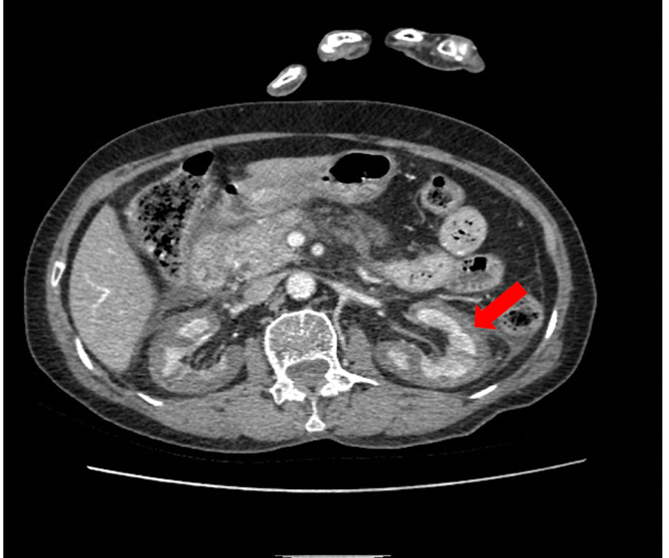
Image courtesy: https://radiopaedia.org
Which of the following is the most likely diagnosis?