Skip to content
Nephro Critical Care Society
  • Home
  • About
    • About Us
    • Our Journey
    • Vision, Mission & Objectives
    • Affiliations
  • Activities
    • Quiz OF The Week
    • Knowledge Sharing
    • Training Courses
    • Research
      • GLOBE RRT Survey
    • Literature
    • 5th Global Update In Nephro Critical Care POCUS IN NEPHRO CRITICAL CARE (PINC)
    • ARCHIVE
  • Blog
  • Media
    • Gallery
    • Videos
      • CRRT
      • AKI
      • Investigations & Biomarker
      • Fluid Therapy
      • Drug Dosing
      • Journal Scan
      • Other Extracorporeal Therapy
      • 5th Global Update In Nephro Critical Care POCUS IN NEPHRO CRITICAL CARE (PINC)
      • 5th Nephrocritical Care Review Course
  • Membership
    • Membership Benefits
    • All Members
    • Plus Members
  • My Account
    • Login
  • Contact Us
  • Home
  • About
    • About Us
    • Our Journey
    • Vision, Mission & Objectives
    • Affiliations
  • Activities
    • Quiz OF The Week
    • Knowledge Sharing
    • Training Courses
    • Research
      • GLOBE RRT Survey
    • Literature
    • 5th Global Update In Nephro Critical Care POCUS IN NEPHRO CRITICAL CARE (PINC)
    • ARCHIVE
  • Blog
  • Media
    • Gallery
    • Videos
      • CRRT
      • AKI
      • Investigations & Biomarker
      • Fluid Therapy
      • Drug Dosing
      • Journal Scan
      • Other Extracorporeal Therapy
      • 5th Global Update In Nephro Critical Care POCUS IN NEPHRO CRITICAL CARE (PINC)
      • 5th Nephrocritical Care Review Course
  • Membership
    • Membership Benefits
    • All Members
    • Plus Members
  • My Account
    • Login
  • Contact Us

QW67 July 2026

Question: Select each option to validate with explanations

Clinical Case Scenario

A 23-year-old non-alcoholic man weighing 55 kgs with osteogenic sarcoma of the right femur;  post- chemotherapy (2 weeks back), presented with febrile neutropenia and profuse watery diarrhoea (8–10 episodes/day) for the past 3 days. He developed oral mucositis with slightly decreased intake for 1 week. He was on long term analgesics (paracetamol & morphine) for past 6 months for severe tumour-site pain.

He was managed in the oncology ward with broad-spectrum IV antibiotics, IV fluids, and electrolyte replacement. His fever resolved. However, during his hospital stay, he developed progressively worsening shortness of breath. Persistent tachypnoea prompted ICU transfer.

In the ICU he was alert, oriented, haemodynamically stable, with normal SpO2 and marked tachypnoea.
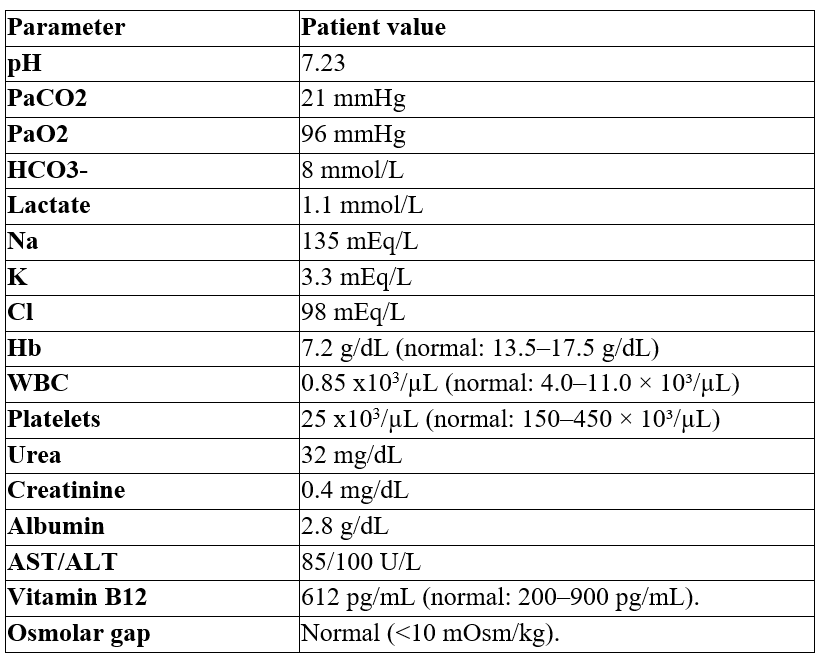
 

CT Pulmonary Angiography- no pulmonary embolism; Lung fields- no infiltrates or consolidation. 2D Echocardiogram- normal.

Peripheral smear showed normocytic normochromic anaemia with leukopenia and thrombocytopenia - pancytopenia without schistocytes, blasts, or immature cells.

Iron studies and vitamin B12 were normal.

Urine ketones were negative.

There was no toxin ingestion history, and the osmolar gap was normal. Corrected AG- 32 mEq/L

The tachypnoea was attributed to the High Anion gap metabolic acidosis.

Medication history

Past medications: Oral Paracetamol 1 g QID for 6 months; Morphine 10 mg BD, Ondansetron TDS and Magnesium oxide OD for 3 weeks.

Current medications: Intravenous- Meropenem, Doxycycline, Paracetamol, Pantoprazole and  Inj Filgrastim

Question: A serum toxic alcohol screen and urine organic acid analysis were sent. Which among these will be  most likely increased in this patient?
😭

Wrong Answer: ❌Beta-hydroxybutyrate: the dominant ketone in diabetic ketoacidosis; urine dipstick may be falsely negative early (detects acetoacetate, not beta-hydroxybutyrate) or remain positive after resolution. This patient was non-diabetic with no starvation history, making significant elevation unlikely.

😭

Wrong Answer: ❌ b) Methylmalonic acid: elevated in vitamin B12 deficiency or inherited methylmalonic aciduria (methylmalonyl-CoA mutase deficiency); this patient's B12 was normal.

😉

Right Answer: ✅ Pyroglutamic acid (5-oxoproline)

Explanation

This patient has high anion gap metabolic acidosis (HAGMA) with preserved renal function and normal serum lactate level. Ketoacidosis is an important differential diagnosis, but the patient was non-diabetic and had no significant history of prolonged starvation to cause clinically significant starvation ketoacidosis. Furthermore, the normal osmolar gap and absence of a history of toxic alcohol ingestion make toxic alcohol poisoning an unlikely cause of the metabolic acidosis. The likelihood of D-lactic acidosis is also low in this clinical setting. Urine organic acid analysis and serum toxic alcohol levels help identify unmeasured anions responsible for HAGMA.

 An important, classic acquired cause of organic acidosis is pyroglutamic acidosis (5-oxoproline) described in patients with chronic paracetamol injection.

 It has also been reported with flucloxacillin therapy.

Mechanism:

Chronic acetaminophen and 5-oxoproline accumulation;
• Chronic acetaminophen use leads to depletion of glutathione and cysteine stores.
• Glutathione reserves become depleted because glutathione is continuously utilized during acetaminophen metabolism. This depletion disrupts the γ-glutamyl cycle, resulting in the accumulation of 5-oxoproline (pyroglutamic acid).
• The underlying mechanism involves the loss of the normal negative feedback exerted by glutathione on γ-glutamyl cysteine synthetase.
• In the setting of glutathione deficiency, this enzyme becomes uninhibited, leading to excessive production of γ-glutamyl phosphate. The excess γ-glutamyl phosphate is subsequently diverted into the ATP-depleting 5-oxoproline futile cycle.
• Concurrent cysteine deficiency further amplifies this pathway, resulting in excessive accumulation of 5-oxoproline.
• As an unmeasured anion, 5-oxoproline produces HAGMA.
• Acidosis is pronounced with additional predisposing factors - malnutrition and sepsis, both of which further deplete glutathione and increase 5-oxoproline production, both present in this patient (mucositis-related poor intake and febrile neutropenia).
Figure: The metabolic pathway.
😉

Management of pyroglutamic acidosis:
Discontinue acetaminophen, provide adequate IV hydration, administer N-acetylcysteine (replenishes glutathione/cysteine and interrupts the futile cycle), and give sodium bicarbonate when severe acidosis warrants correction.

Mnemonic — GOLDMARK (causes of HAGMA)
G – Glycols (ethylene glycol, propylene glycol)
O – Oxoproline (5-oxoproline / pyroglutamic acid)
L – L-lactate
D – D-lactate
M – Methanol
A – Aspirin (salicylates)
R – Renal failure (uremia)
K – Ketoacidosis

TAKE-HOME MESSAGE

💎 Not every tachypnoeic ICU patient has a lung problem.
💎 When lactate, ketones, osmolar gap, and renal function appear unrevealing, think beyond the common causes.
💎 Chronic therapeutic paracetamol + sepsis + malnutrition = Think Pyroglutamic (5-Oxoproline) Acidosis.

😭

Wrong Answer: ❌ Propylene glycol: accumulates with prolonged administration of propylene-glycol-containing drugs (e.g., IV lorazepam, diazepam, nitroglycerin). This patient did not receive any of the drugs..

This field is for validation purposes and should be left unchanged.
Nephro Critical Care Society

All rights reserved